construct 3d · blueprint · beat'em up
Over the Garden
Gameplay Programmer · Game Artist · Game Designer
Take on ruthless vegetables on a battlefield.
Plant them to reap a bountiful harvest and win the game.
Game Design
Over the Garden is a top-down beat'em up for PC, made by a team of three with Antoine Vacherie and Léa Margnes. The intent: create a contrast between demanding gameplay, which should take more than one try to beat, and a cartoonish, childlike, cheerful art direction.
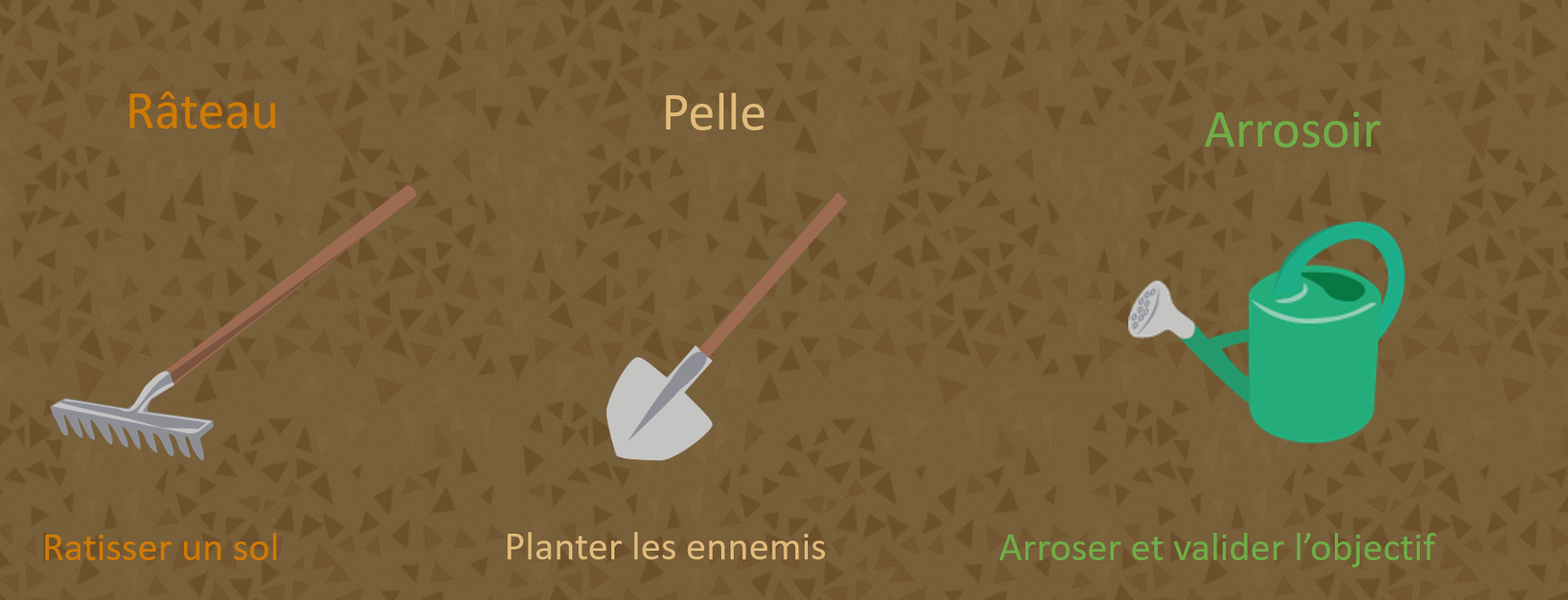
Game Design · Core loop
Rake, plant, water
Enemies aren't killed, they're planted. The player has three gardening tools to use in a precise order on the field's plots to turn an enemy into a point toward the objective.
- Rake (L1): prepares an unprepared plot
- Shovel (Square): plants an enemy crossing a prepared plot, with timing that depends on its size and speed
- Watering can (R1): waters a planted plot and adds the point to the objective
- Every swing triggers freeze frames: the player commits to each action and has to read the field before acting
- Nested objectives: plant one enemy, fill a quota (e.g. 3 chilies, 15 carrots, 5 potatoes), then complete the global objective to win, with only 5 HP
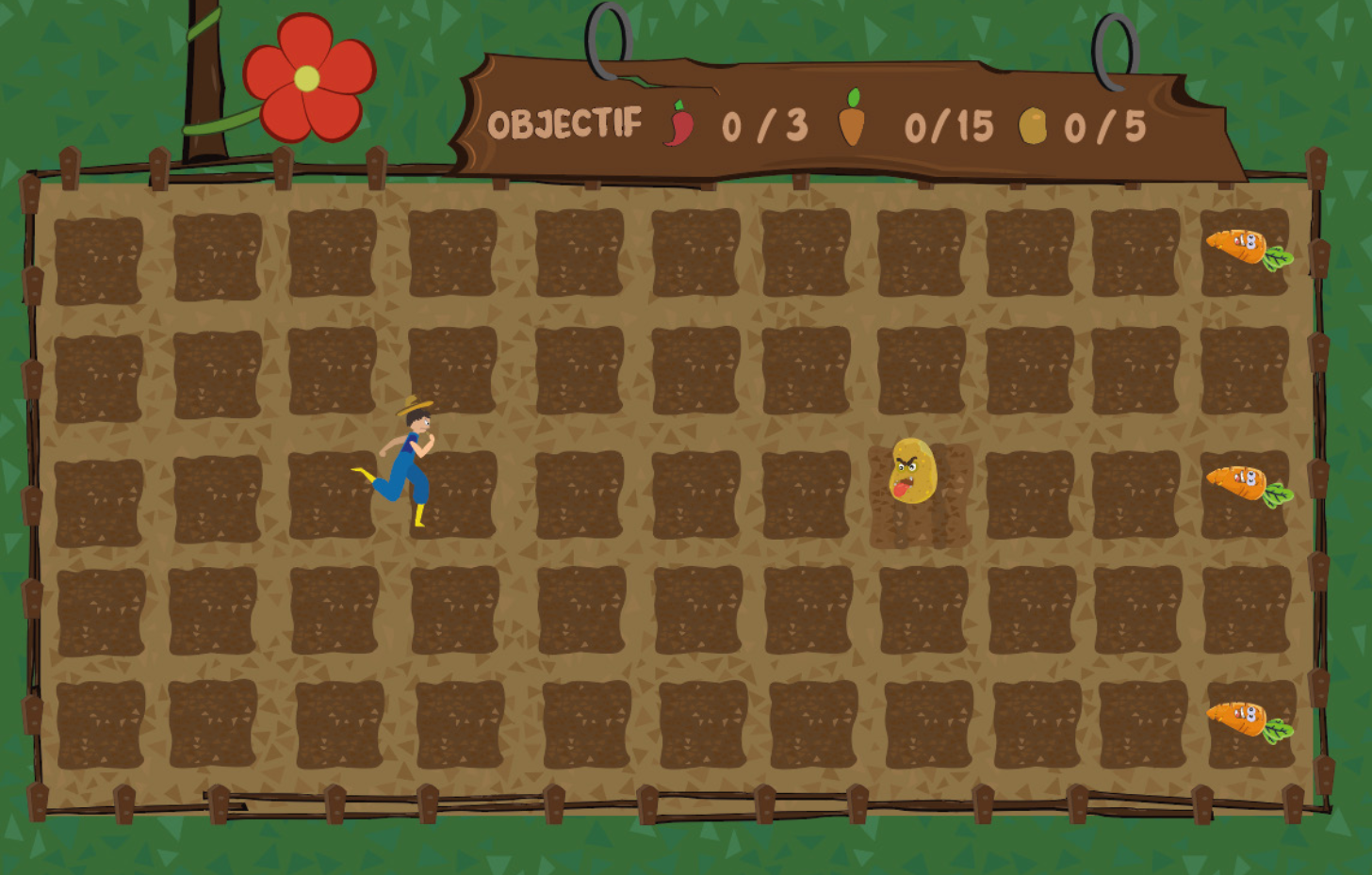
Game Design · Iterations
From side view to a readable grid
The first version was in side view: three weapons, each able to plant one enemy type, and a timer to add pressure. Managing space wasn't readable, so the game moved to a top-down view, then to a grid of plots inspired by Plants vs. Zombies.
- Top-down view with 3/4 of the screen for play, then every element scaled down to free up space
- Enemies first all chased the player; each then got its own pattern (Moonlighter reference) so their paths become information to read
- Prediction loops designed around key situations: plant the potato before the carrot arrives, rake a plot ahead of a carrot wave, plant the chili now or save the spot
- Camera: top-down on the field, but characters face the camera in side view
Game Programming
Gameplay programming in Construct: the plot state machine tied to the tools, each enemy's behavior and the feedback that makes every action readable.
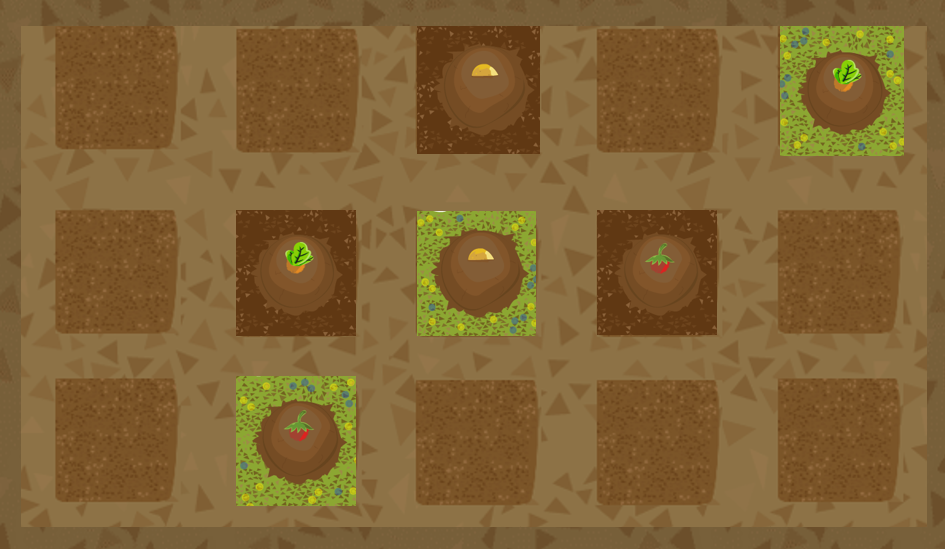
Game Programming · Systems
Plot state machine
Each plot goes through four states: unprepared, raked, planted, watered. Each tool only acts on the matching state, turning the design's tool order into a simple, robust rule.
- The shovel only plants if an enemy overlaps a raked plot when the hit lands
- Watering a planted plot increments that enemy's counter on the objective sign; the victory screen loads once every quota is met
- A missed hit leaves the plot untouched and plays a whoosh, so the player understands why nothing happened
- Taking a hit removes 1 HP and triggers the falling-petal animation; at 0, the game-over scene loads
Game Programming · AI
Three enemies, three patterns
Each vegetable has its own movement, so the field always gives the player something to anticipate.
- Potato: the only one that targets the player. A target follows them; once they're on it, the potato rolls straight at them. A warning sign shows where it will spawn
- Chili: slow and fearful, it sweeps up and down the field and shifts one tile over at every wall
- Carrot: spawns on one side of the field and drills straight across it, in waves
- Adaptive music: three versions of the same jazz track (120 BPM) whose drums build up with the number of enemies on screen
Game Art
A cartoon style deliberately at odds with the gameplay's challenge. Every color choice serves readability: a flat, dark background, warm-colored enemies and a cool-blue farmer who stands out from everything else.
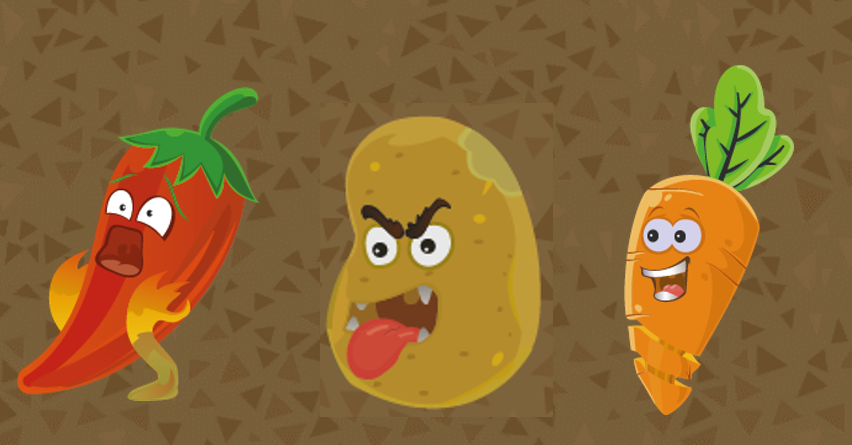
Game Art · Characters
Characters with readable personalities
Each enemy's personality comes through its eyes and posture, and its design explains its behavior.
- Chili: the first enemy designed, it set the art direction. With no legs, it walks on its flames, with Hermes-style winged boots for readability
- Potato: the most iterated, a dim-witted brute inspired by Cuphead and Taz, with a bite on its skull for a zombie touch
- Carrot: cheerful and harmless-looking, its tail becomes a drill to explain why it deals damage
- Farmer: based on a Ben 10 reference, animated from photos of real rake, shovel and watering-can gestures (run and attack sprite sheets)
Game UI Sheet
This sheet brings together all my Game Art work on the project: the characters, from sketches to animations, the weapons, the ground tiles, the background and the UI elements. Scroll down to see it all.
